Picking a start date for your Australian degree is not just a calendar decision. It changes which courses you can get into, how much competition you face, and even how your visa application is assessed.
Most students hear the term “January intake” and assume classes begin in January. In Australia, that is not quite right, and getting this detail wrong can cost you weeks of planning time.
This guide breaks down what Semester 1 (the intake most people call “January”) and Semester 2 (July) actually offer, using current 2026 figures, so you can pick the one that fits your course, your English test timeline and your budget.
What “January Intake” Actually Means in Australia
Australian universities do not open their academic year in January. Semester 1 classes usually start in late February or early March. Students call it the “January intake” because that is when visa paperwork, offer acceptance and final preparation need to happen.
Semester 2, commonly called the July intake, runs from late July to early August.
So when people compare “January vs July,” they are really comparing:
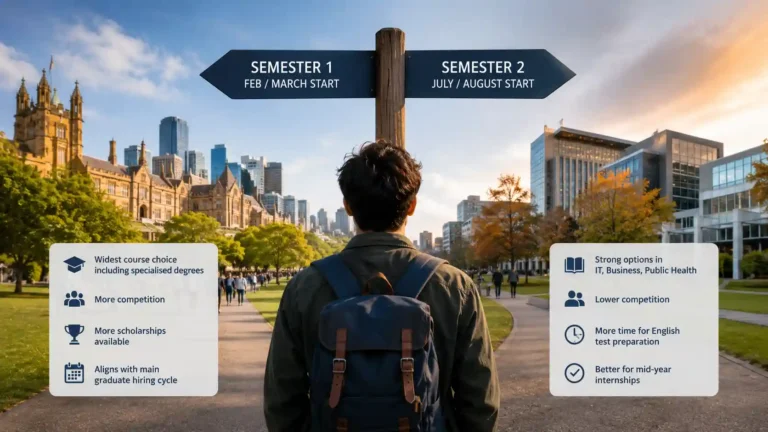
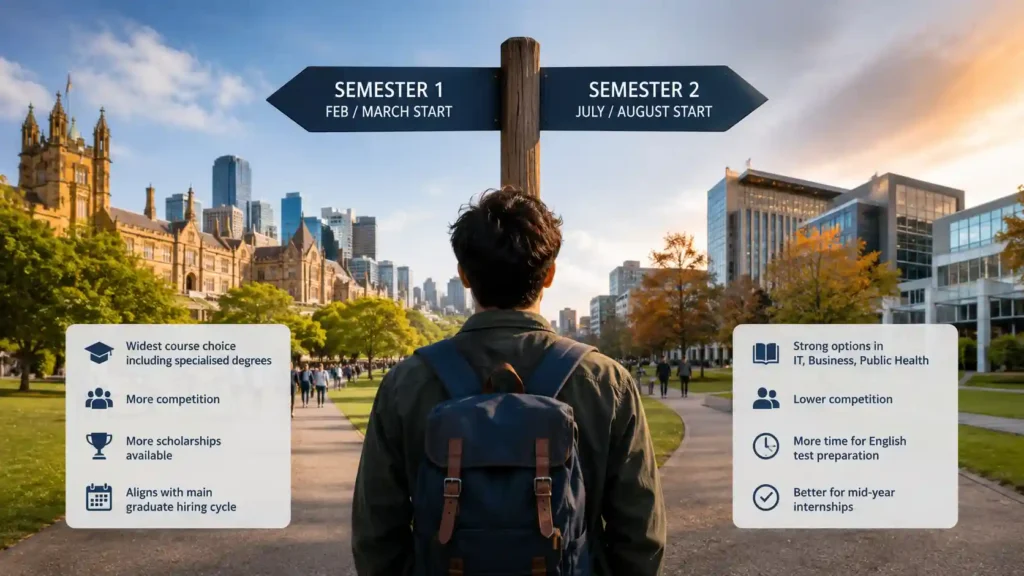
- Semester 1 (Feb/March start) – the main intake with the widest course list
- Semester 2 (July/August start) – the secondary intake with strong options in specific fields
Knowing this distinction matters. If you are told to submit documents “by January,” that is your preparation deadline, not your first day of class.
Quick Comparison: Semester 1 vs Semester 2
| Factor | Semester 1 (Feb start) | Semester 2 (July start) |
| Course variety | Widest range, including Medicine, Law, Engineering | Good range, strongest in IT, Business, Public Health |
| Competition | Higher, most popular choice among applicants | Lower, smaller applicant pool |
| Scholarships | Most merit-based scholarships open here | Fewer scholarships, some faculty-specific awards |
| Visa processing | Can overlap with Christmas and New Year holidays | Steadier processing outside the holiday rush |
| Preparation time | Tighter if you are finishing exams late in the year | More breathing room for English test retakes |
| Job market alignment | Matches Australia’s main graduate hiring cycle | Better suited to mid-year internships |
Course Availability: Where the Real Gap Is
Semester 1 remains the strongest intake for course choice. Nearly every undergraduate and postgraduate program is open, along with specialised streams in Medicine, Law and Engineering that rarely run twice a year.
Semester 2 is not a lesser option though. Several universities run dedicated mid-year starts for popular postgraduate programs. The University of Queensland, for example, offers a July start for its Master of Public Health, and RMIT opens select engineering postgraduate courses in the same window.
If your target course is highly specialised, check the specific university’s intake calendar before assuming July will have a seat. A quick way to confirm is through the Study Australia course search, which lists current CRICOS-registered courses by intake.
Visa Costs and Timing for 2026
Visa costs affect your intake decision more than most students realise, since fees have increased twice in the past 18 months.
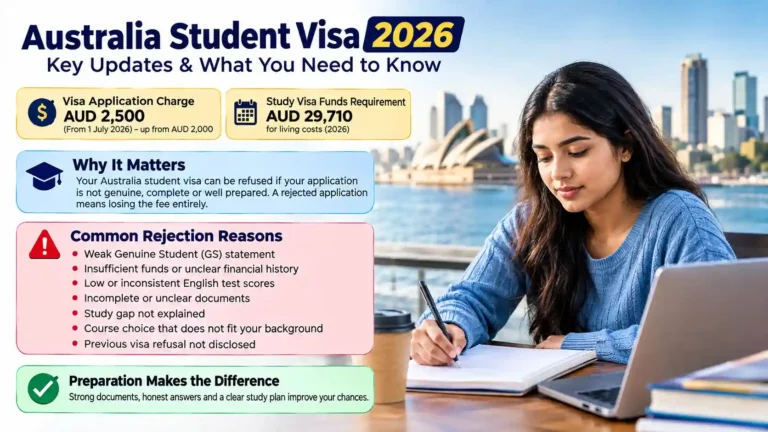
From 1 July 2026, the Student visa (subclass 500) application charge sits at AUD 2,500 for the primary applicant. This is confirmed on the official Study Australia visa page, and it applies regardless of which intake you choose.
The financial capacity requirement for 2026 is AUD 29,710 per year in living costs for the primary applicant, with additional amounts required for a partner or dependent children.
A few practical points on timing:
- Semester 1 visa applications often overlap with the Christmas and New Year period, which can slow document processing on your end
- Semester 2 applications tend to move through a steadier processing window
- Processing times vary by country and course provider, so always check current figures on the Department of Home Affairs global processing times page before locking in a date
Since March 2024, all applicants are assessed against the Genuine Student (GS) requirement, which looks at your study intentions, financial circumstances and ties to your home country. This applies the same way for both intakes, so there is no timing advantage on this front.
English Test Scores: Same Bar, Different Runway
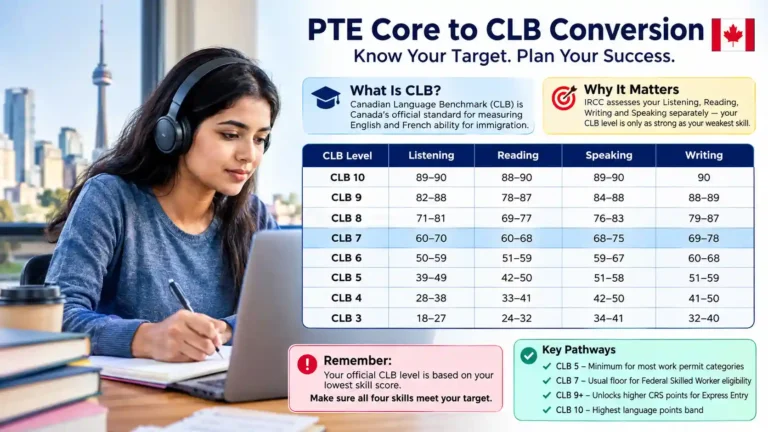
Both intakes require the same English score for the visa itself. As of 2026, the Department of Home Affairs accepts PTE Academic, IELTS (Academic or General Training) with an overall band of 6.0 and no component below 5.5, or TOEFL iBT, among other approved tests.
Universities and specific courses often set higher entry scores than the visa minimum, so always check your target course page directly.
Where the intakes really differ is preparation time.
If you are applying for Semester 1, your test window is tighter, especially if your final exams run late in the year. A Semester 2 target gives you extra months to retake PTE if your first attempt falls short, without derailing your whole plan.
This is exactly why many students choose a shorter, structured course over trying to self-study on a deadline. Our PTE Accelerated Course is built for students working against a tight Semester 1 timeline, while the PTE Standard Course suits those with a longer runway toward July.
You can check where your current level stands with a free PTE Mock Test before committing to either intake.
Scholarships and Financial Planning
Most merit-based and research scholarships are allocated during Semester 1 offers. If funding is a major factor in your decision, Semester 1 gives you access to a wider pool.
That said, Semester 2 is not scholarship-free. Some universities, including the University of Sydney and UNSW, run faculty-specific awards for mid-year starters. These are smaller in number, so early contact with the university’s scholarships office is worth the effort if you are targeting July.
Job Market and Career Timing
Semester 1 graduates typically finish their degree in time for Australia’s main graduate hiring cycle, which runs through the second half of the year. This can matter if you are planning to move straight into full-time work or a graduate program after finishing your studies.
Semester 2 starters usually graduate mid-cycle, which can work well if you are targeting internships or industry placements that run outside the standard graduate recruitment window.
For a clear picture of graduate employment outcomes by field, the QILT Graduate Outcomes Survey publishes independent, government-backed data each year.
Which Intake Should You Actually Target?
There is no universal right answer here. It depends on three things: your course, your test readiness, and your finish date for previous studies.
Target Semester 1 if:
- Your course (Medicine, Law, or a specialised Engineering stream) is only offered once a year
- You want the widest scholarship pool
- Your final exams or previous qualification wrap up well before the end of the year, giving you time to prepare
Target Semester 2 if:
- You need extra months to reach your required PTE or IELTS score
- Your final results come through mid-year, closer to a July start
- You want a calmer visa processing period, away from the holiday backlog
- Your target course runs a strong mid-year intake, such as IT, Business or Public Health
Whichever intake you choose, build your English test preparation into the plan early. A late PTE attempt is the single biggest reason students miss their intended intake altogether.
Getting Your PTE Score Ready, On Either Timeline
Whether you are six months out or racing toward a Semester 1 deadline, the PTE score requirement does not move. What changes is how much time you have to hit it comfortably.
Here at ACE Language, our PTE courses are structured around real intake deadlines, not generic study plans. If you are unsure which course pace suits your timeline, our team can walk you through it during a free consultation.
For a deeper look at how the PTE exam itself works, including scoring changes, our guide on why PTE is a strong choice for Australian visa applications covers the format in detail.
Frequently Asked Questions
Is the January intake in Australia actually in January?
No. What people call the “January intake” is Semester 1, and classes generally start in late February or early March. January and early February are used for finalising visas, accommodation and pre-departure preparation.
Which intake has less competition, January or July?
Semester 2 (July) generally has a smaller applicant pool, since most students target Semester 1 first. This can mean a smoother admissions process, though it does not guarantee an easier visa outcome, since the Genuine Student assessment applies equally to both.
Do I need a different PTE score for the July intake compared to Semester 1?
No. The English language requirement set by the Department of Home Affairs does not change between intakes. Some universities may set a higher course-specific score, so always confirm with your chosen institution.
Can I switch from a July intake to Semester 1 later if my plans change?
In most cases, yes, provided your course offers both intakes and you meet the updated application deadline. Speak to your university’s admissions team directly, since deferral and transfer rules vary by institution.
Is it harder to get a scholarship for the July intake?
Scholarships are more concentrated in Semester 1, but they are not exclusive to it. Some universities run mid-year, faculty-specific scholarships, so check directly with your target university’s scholarships page before ruling out July.
How much does the Australian student visa cost in 2026?
From 1 July 2026, the subclass 500 visa application charge is AUD 2,500 for the primary applicant, as confirmed on the official Study Australia website. This fee applies regardless of which intake you choose.